“An acute sense of justice would not allow me to stand aside — I knew I had to be there”

Solomiia “Gloria” Chernykhivska is a former military correspondent of the Azov press service, a veteran, and a sister-in-arms of the VETERANKA movement.
Solomiia Chernykhivska has gone from a student of a music academy to a military correspondent of Azov, where for more than five years she documented the war from within. Today she works in the defense sector and preserves the memory of the fallen, for whom she became both a voice and a chronicler.
Before her service, Solomiia Chernykhivska was a student at a music institution, where she studied the piano. She had strong musical abilities from childhood, so she entered music school early, then college, and later the academy. According to her, this path seemed the only possible one for her and for her parents.
At the same time, Solomiia was raised from an early age in a patriotic environment, and later took part in the nationalist movement.
“At that time, none of us could even imagine that very soon we would all become soldiers,” the now veteran shares.
The turning point for her was the Revolution of Dignity
“An acute sense of justice simply would not physically allow me to stand aside and observe. I began to volunteer, wrote materials in English for an international audience — I tried to explain to the world what was happening in Ukraine, what the war in Donbas was, and why it matters not only for us. But over time I felt more and more sharply that this was catastrophically not enough,” she shares.
Just before finishing her studies, Solomiia was contacted by an acquaintance who was serving in Azov and offered her to join the army.
“My first reaction was something like: ‘But I am a girl — they simply will not accept me, what are you talking about.’ But he explained that the situation was different from what I imagined, because at that time the unit needed people in the press service, and he knew very well about my journalistic materials and understood that I was suitable,” the veteran recounts.
She contacted the head of the Azov press service and completed a test assignment, and after defending her diploma at the university and a short trip abroad, she packed her things and went to Mariupol.
Later, the serviceman who had suggested that she join Azov was captured by the enemy during the battles at Azovstal in Mariupol — he remains in Russian captivity to this day.
At first, Solomiia’s relatives categorically did not accept her decision to serve, especially since she carried out assignments in Donbas, where intense combat operations were taking place.
“In their imagination, I was packing a backpack and going straight into the trenches, under shelling, toward the unknown. But over time they saw that I was in relative safety, that I liked the work and felt in my place. Gradually their anxiety receded. I have never — neither then nor afterwards — regretted my choice,” the veteran says.
The story of the call sign
In our environment, a call sign is something special, and you have to come up with one yourself before your brothers-in-arms invent something for you that you will then have to live with for years. I wanted a name, not a nickname or a characteristic, because I felt that something fundamentally different, a new life, was beginning, and I wanted to enter it with a new name, as if shedding old skin.
I liked the name Aurora — beautiful, sonorous, with a certain symbolism of dawn and the beginning of something new. But I found out in time that this was the name of a nightclub in the city of our deployment, which was quite popular — fights regularly took place there. The associations were not exactly what I had in mind, so the option had to be discarded.
Shortly before leaving for Mariupol, I traveled abroad and admired the architecture, especially old churches with their monumentality refined over centuries. On the facades I kept encountering the Latin word “Gloria” (from Latin “glory” — ed.) — it is also engraved on the Dominican church in Lviv. I decided that this was exactly the word I needed — and it became my call sign.
The beginning of work in the Azov press service
At first I worked as a volunteer, later I signed a contract and served as a military correspondent for 5.5 years, 4 of which were on a contractual basis.
Azov has always built its identity around the highest standards of combat training, and this permeated literally everything — from daily training to the overall culture of the unit. And we, as a group of information and communication work, documented this from within in real time: the everyday life of the fighters, official events, training, trips to the front.
We were at the training ground, during drills, on garrison duty, on the front line, and gradually became true “chroniclers” of the unit — people who preserved its memory and voice.
In 2017, I went to the front line for the first time — to Shyrokyne. It was then that I first saw with my own eyes how war turns the living into the dead. Houses burned to the ground, a bombed-out school, mangled cars, a market riddled with shrapnel, a café where festive “Congratulations on your wedding” posters still remained on the wall. Records and books scattered across the school floor, abandoned belongings and photographs in empty houses. It stunned me to the depths of my soul.
The return of a fallen comrade’s body
At the end of 2018, there was a large combat deployment of the Azov battalion tactical group for coordination and then to the Svitlodarsk arc. I went there as part of my work assignments. Near almost every position there was a dead Russian soldier who had not been taken away. That in itself said a lot, but there is one story from that deployment that I remember in detail.
Azov fighter Roman Romanenko, call sign “Bich,” was killed on August 10, 2019, when he detonated an enemy explosive device. He was 25 years old; he was born and lived in Dnipro before joining the regiment at the end of 2015. During that time, he managed to become the commander of a sniper section.
After his death, Roman’s body ended up in enemy-controlled territory, and despite numerous attempts to retrieve their comrade under heavy fire, it did not succeed. The Russians took the body. It took the Azov fighters three days to arrange a transfer — Roman’s body was retrieved only on August 13.
For the exchange, our fighters decided to hand over to the enemy one of those same “stiffs” — a dead Russian soldier whom they named Valera. The Russians had long abandoned the fallen man, taking only his rifle.
They brought the occupier’s body to the exchange point, and the Russians said they did not need him and that we could do whatever we wanted with him. Then our fighters took “Valera” back and buried him properly. They treated the enemy better than his own comrades did. I think this episode says much more about the differences between us and the Russians than any rhetoric.
A new position and discharge from service
Later I began to perform the duties of head of the press service. The workload was enormous, the team was truly good and cohesive, but over time I felt emotional burnout more and more clearly. My contract was ending, I was offered a promotion in rank, but on the condition of signing a contract for another three years. I weighed everything and decided that it was beyond my strength and limits, so I made the decision to leave the service.
Two months before the full-scale invasion, I moved away from Mariupol, and I perceived the news about the likelihood of an invasion as another scare story. It seemed to me that no one really believed that such a thing was even possible.
The full-scale invasion
The day before the full-scale invasion, a comrade called me and suggested that I return. He said that there would soon be a lot of work and all hands would be needed. I replied that by the time I packed my things, got to the station, and traveled for 30 hours by train, everything would already end by itself. But what happened, happened.
I wrote to friends who remained in already encircled Mariupol, tried to support them at a time when I could help in no other way, and at the same time understood more and more each day that the situation was critical and that words were powerless.
The hardest part was living through the loss of people with whom I had shared army life for years — those whose voices still sound in my memory, and whose bodies, some of them, have not been found to this day.
A documentary project about the fallen
In Azov, special importance has always been attached to the memory of the fallen — it was an internal duty to those who did not return from the battlefield. Every year, a detailed publication about a fallen fighter was обязательно released, a ceremonial lighting of memorial lights was held, and once a year — on the so-called Day of the Dead — all the fallen were remembered, relatives were invited, and it was emphasized that their Heroes were not forgotten.
My sisters-in-arms and I, with whom we served in the press service, decided that it was precisely we who had to carry out this mission for the defenders of Mariupol — for our friends who are no longer here.
For two years I conducted interviews with relatives, brothers-in-arms and sisters-in-arms of the fallen and wrote articles about them for a documentary project. I tried to reconstruct their images not as abstract heroes, but as living people with their own characters, habits, and touching and even funny details. It was not easy. Relatives often knew almost nothing about them as warriors — the fighters deliberately did not tell their loved ones so as not to worry them, not to pull them into their reality. And there were times when it was I who told the families about their son, husband, brother — about what he was like in the unit, how he held himself, what he lived by. These were at once the hardest and the most important conversations in my life.
Returning to civilian life
The topic of returning to civilian life is extremely relevant today, when hundreds of soldiers are returning from the front — with psychological and physical wounds, with experiences that have no analogues in peaceful life, and with a sharp sense of their own alienation in a familiar world that continues to spin according to its own laws.
In the army, in a certain sense, it is easier to live: you know where the enemy is, there are people next to you who understand you without explanations, there is a clear structure and an undeniable purpose.
Can a person who has gone through war return to peaceful existence completely — not physically or in everyday terms, but morally and internally? I have not been in the hell of war in the sense that this phrase has come to mean after the full-scale invasion — because with its beginning the very scale of cruelty and cynicism has shifted so much that what once seemed unthinkable has become routine. But honestly — I do not know the answer to this question. There, such a deep reassessment of values and such a radical reordering of priorities takes place that it does not let go and does not dissolve over time.
In my case, there was also another specific dimension — being a woman in a predominantly male collective. This implies at the very least the ability to speak the same language with them, to understand their logic and culture, not to get lost and not to retreat. And at most — to consistently and without unnecessary words earn respect first of all as a person and a professional, not through the prism of gender. For me this has always been fundamentally important, and it was on this foundation that I built all my cooperation and communication — both with the fighters and with the command.
In Azov there is a phrase that is mentioned very often: “There are no former Azov fighters.” And this is a truth you feel from your own experience. Even when you are no longer there, you continue to keep in touch, you follow what is happening, and you simply cannot do otherwise — because there you meet people alongside whom you yourself become better, and whom it is no longer possible to simply erase from your life.
After completing the documentary project, I work in the communications department of a group of companies in the defense sector — we produce drones, body armor, tactical gear, and other critically important equipment for the army. Because now the logic of the time is simple and indisputable: you must either be directly at the front or work for the front.
Over these years, so many stories have accumulated that it is impossible to recall them all at once — both dramatic and those that make you laugh through tears. But when I try to understand which of them have truly stayed with me and do not let go, the answer is always the same: all of them are about people. About those who gave their lives. About those who are still in captivity. And about those who came out — and continue, without stopping, to bring death to the enemy.
Expectations from the activity of the Movement’s branch in Lviv
My expectations from the activity of the Movement’s branch in Lviv are primarily connected with the formation of a strong, trusting community where women veterans can feel not only support, but also a deep sense of belonging. It is about a space of mutual understanding without unnecessary explanations, where each person’s experience is received with respect and empathy.
Since I work in the defense sphere, there are veterans in my professional environment, but mostly they are men. At the same time, I feel a certain difference between such interaction and the presence of a specifically female community — one that is more sensitive to the nuances of lived experience, emotional support, and inner transformations.
I have participated in retreats for veterans, and it was a deep, transformative experience. Such formats demonstrate especially clearly how important it is to have people nearby with similar experience — those who understand without words.
As a woman veteran, it would be very valuable for me to have in everyday life a more constant sense of such a community — not episodic meetings, but a systemic, living presence. I would like the branch in Lviv to develop as a space of support, growth, and mutual strengthening — a place to which one wants to return for a sense of community, strength, and meaning.
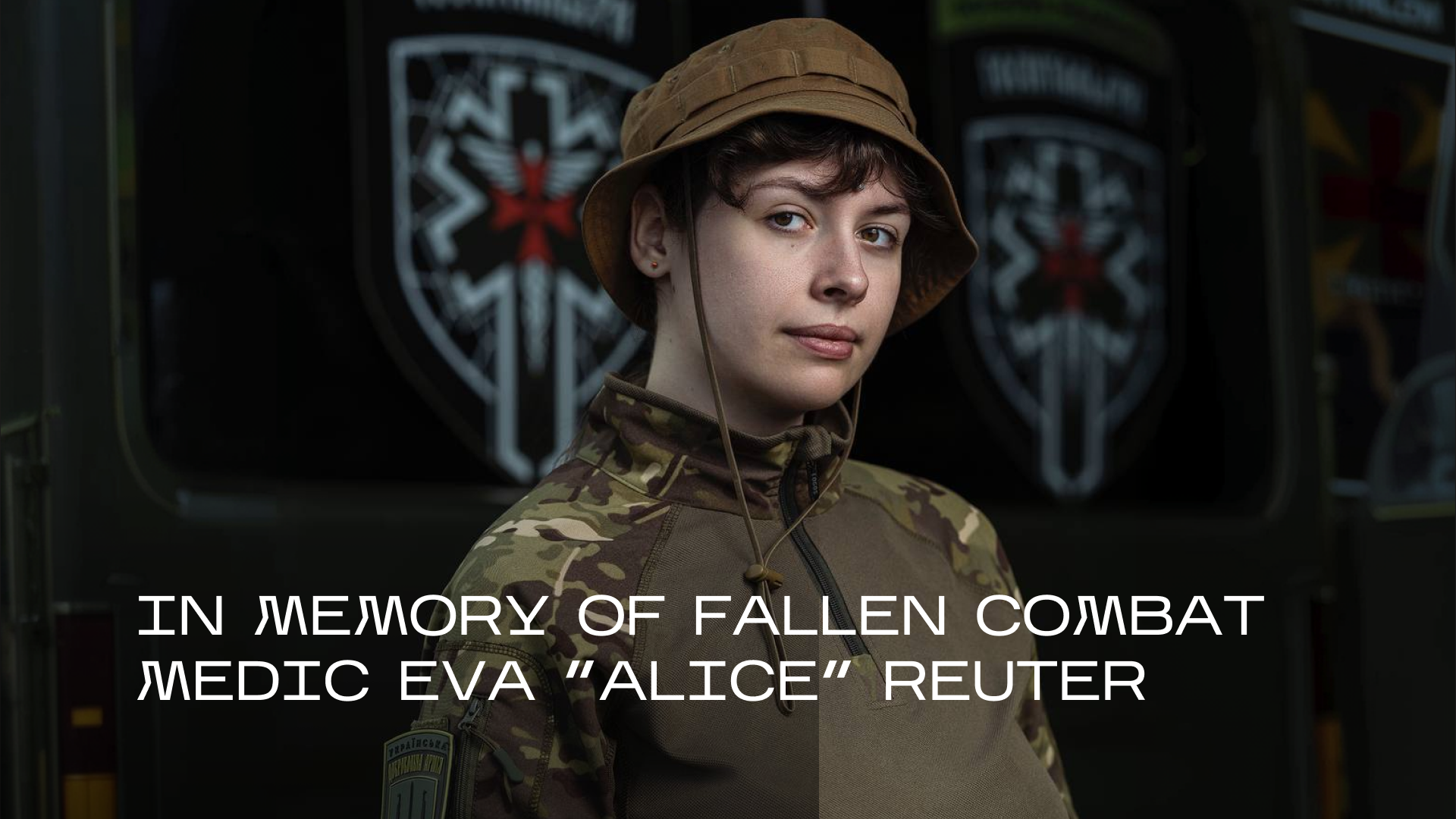 An art historian who became a combat medic, mastered drone repair, FPV drones, 3D printing, led international recruitment, and coordinated a major educational project
 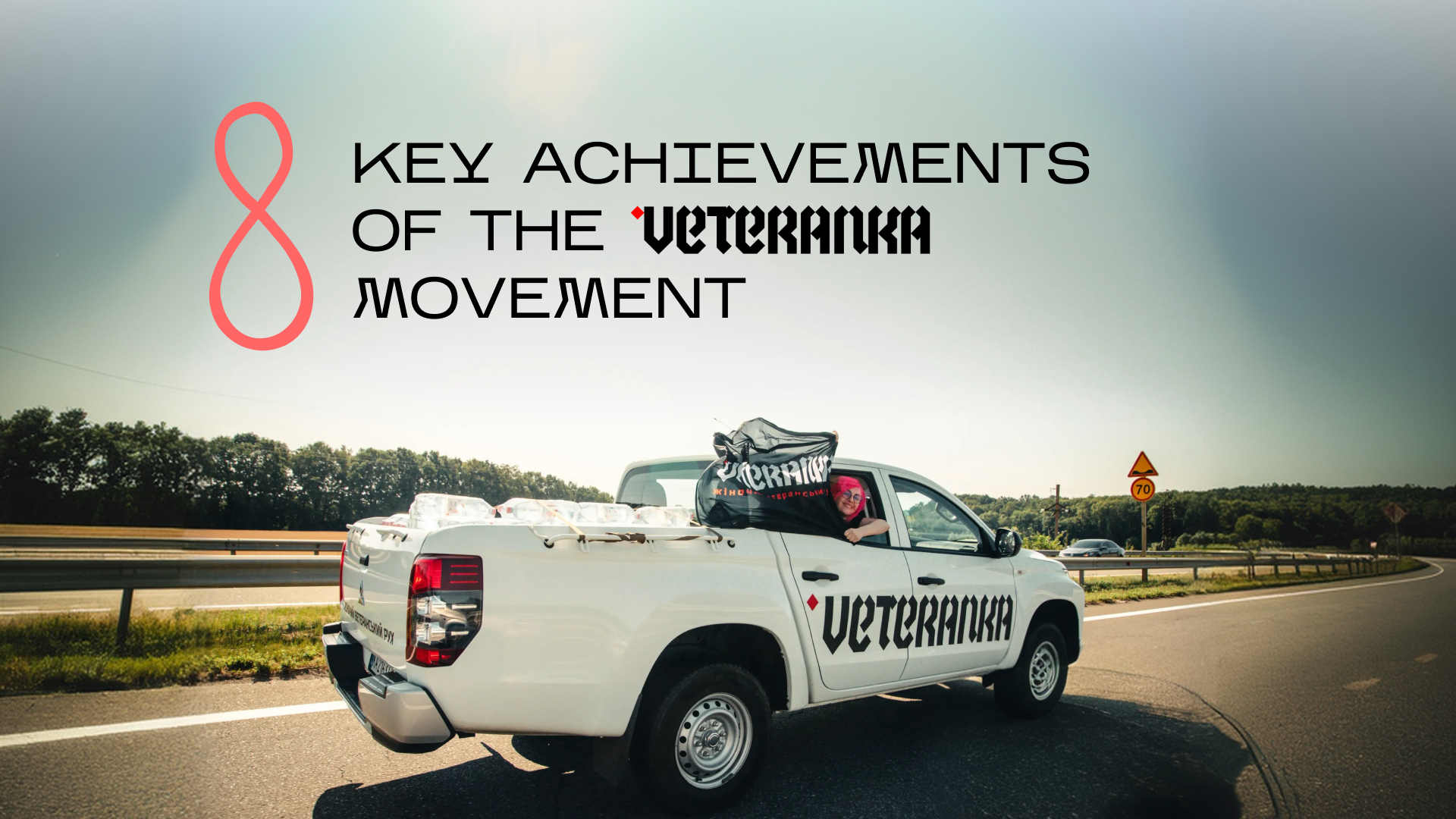 To Mark the 8th Anniversary of the VETERANKA Movement
 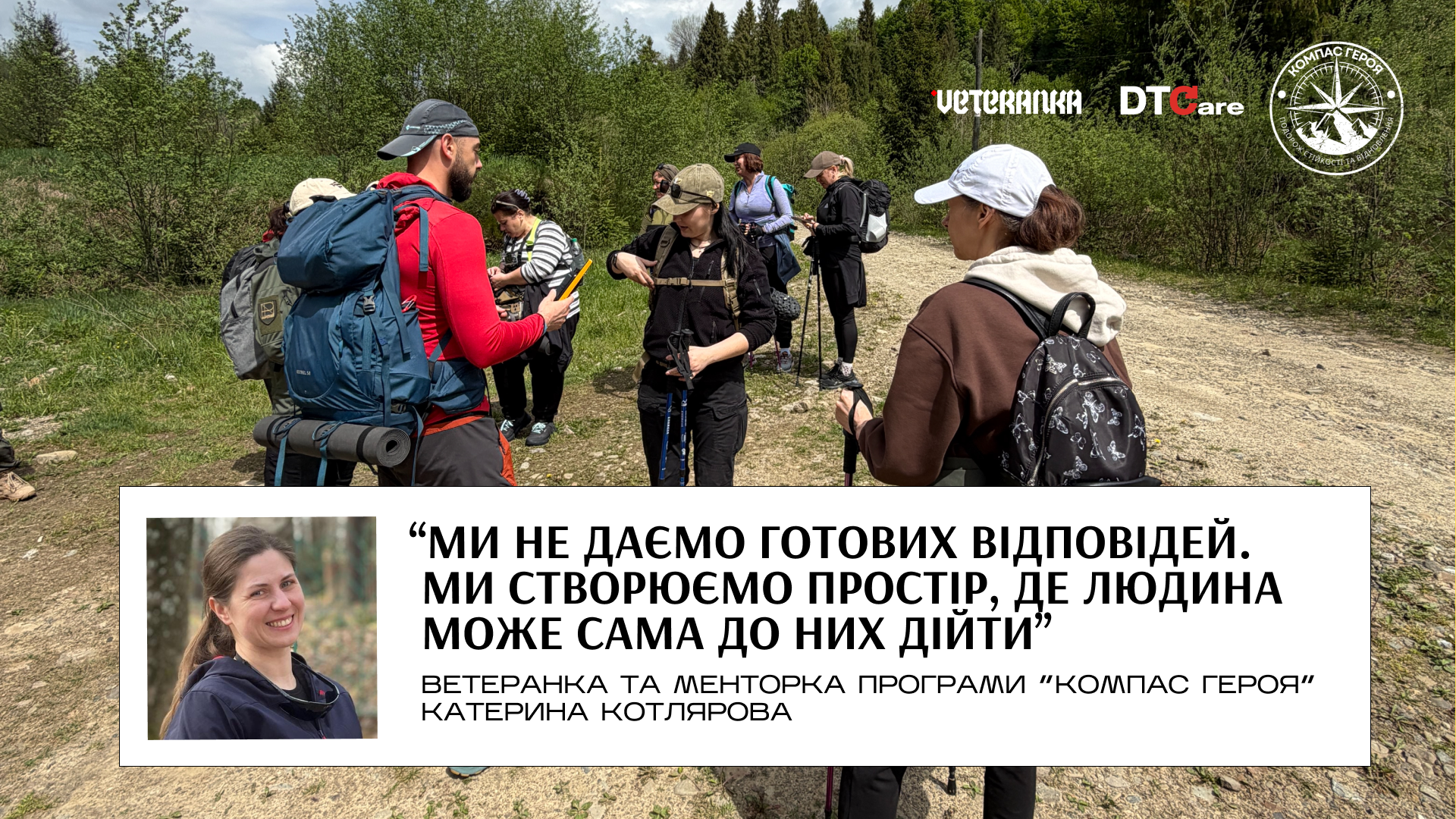 What Awaits Participants of the Hero’s Compass Adventure Counseling Program
 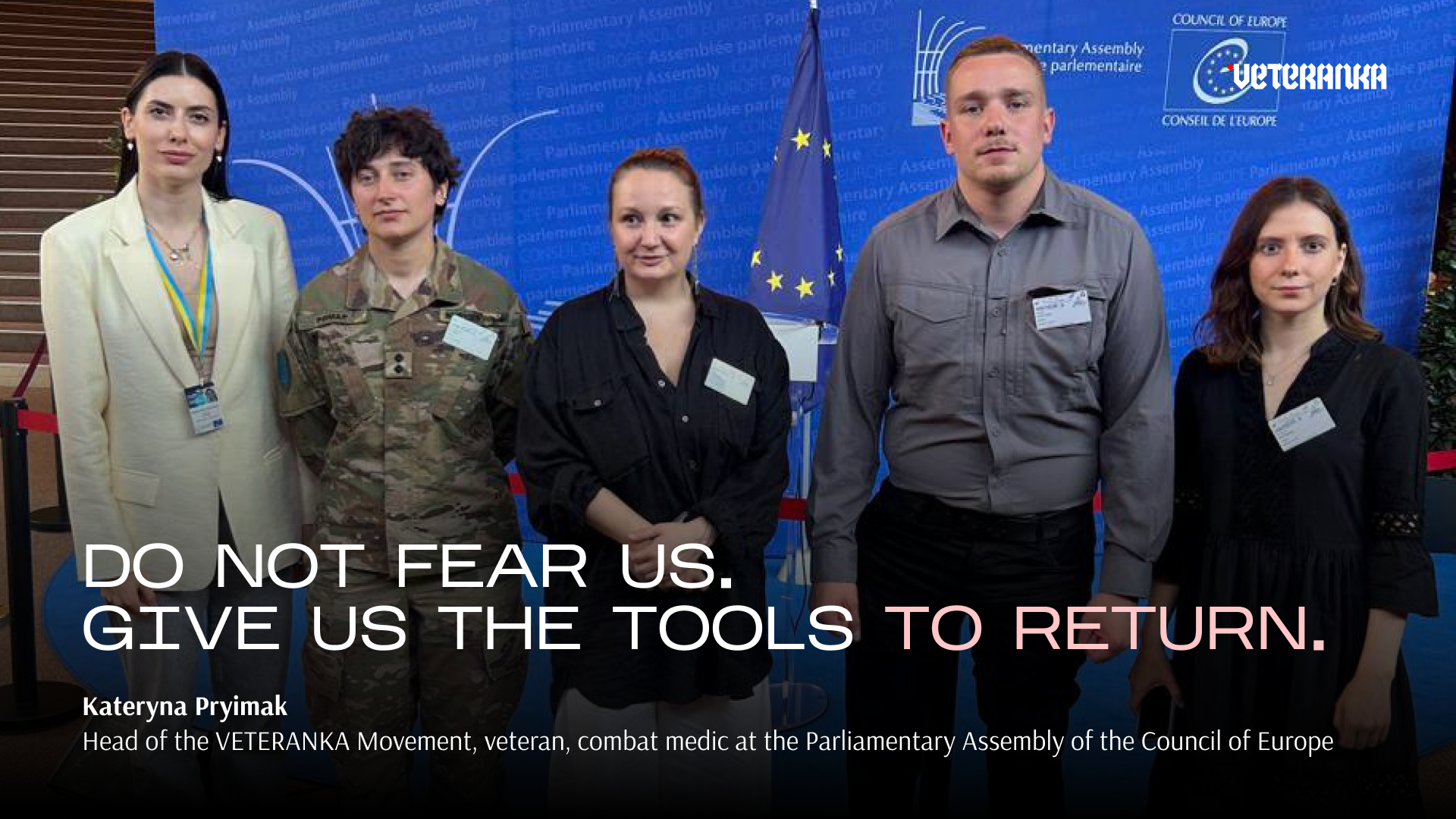 "Do not fear us. Give us the tools to return"
  “Life does not end after service — it becomes different”