CO-FOUNDERS OF VETERANKA

Mariia Berlinska

1. Before 2014, I studied at the Kyiv-Mohyla Academy, Faculty of Humanities. I planned to study historical science and cultural management.
2. I decided to join the army as a volunteer in the summer of 2014, when the war broke out. It was the most logical and obvious decision for me at the time. It did not come easy to me. Of course, I was very scared, but courage is not when you are not scared. It is when you are scared, but you still force yourself to go forward. In the beginning of September, I joined Dobrobat in Luhansk region. It was there that I started working with drones, which had just appeared in the war. And now they have become one of the determining factors, a game changer in our already full-scale war. The decision to join Dobrobat was simply the decision of a person who understood that someone had to do it, and why not me.
3. At the time of the founding of the Movement, I was a person who believed very strongly in uniting girls who were volunteers and soldiers. I saw the huge potential of Ukrainian girls from the very first years of the war, I saw that when they returned to civilian life, they did not go to get one’s shirt out and tell how they were burning in a tank, but plunged into volunteering, helping their sworn brothers and sisters. I saw extraordinary potential behind the girls, and, at the same time, I saw the pain that every girl who had actually fought had. I realised that only by uniting could we help each other and turn this pain into our superpower. In the autumn of 2016, I came up with the idea of creating the Movement. I am very grateful that the girls just believed in this idea, and together we gave it a start and implemented it. Indeed, today the Movement is one of the most powerful veteran volunteer organisations in Ukraine and, I’m not afraid to say, one of the most effective veteran organisations in the world. I am very proud that we once created this together.
4. As for my influence on the Movement, at the initial stage, at the moment of the idea and the start, I was the person who was to some extent the ideologist of the creation of this process. I think that we started making some basic settings together with the girls in early 2018. And then in 2018-2019 we started. Then I just stepped aside and switched to working on other projects. And the girls, my sisters, gave it all scale and altitude, led the Movement to where it is now – one of the coolest veteran and volunteer organisations in the world.
5. As of August 2024, I am the head of the Victory Drones volunteer project. This is a project of technological militarisation of society. It is the largest project for the training, provision, and promotion of military technologies in the security and defence sector. Already for 10 years, I have been believing in technology as an asymmetric, smart response, a flexible response to such serious challenges set by a much more resource-intensive, stronger, more powerful enemy in terms of resources and number of people. I believe that this is a battle between David and Goliath, where David should have technology instead of a sling. Accordingly, two and a half years after the full-scale invasion, I have returned to the topic of drones, robotic systems, and the entire technology ecosystem. Together with my colleagues, we are implementing this ecosystem to the fullest extent possible, turning technology in warfare into a rock concert move that allows us to save the lives and health of tens of thousands of our people. I believe that with a reasonable approach, this will allow us to defeat Russia and destroy its military capabilities for aggression
Andriana Arekhta “Malysh”

1. Until 2014, I was a girl who wanted to travel, build a career and live happily ever after. I worked for a company that sold and developed luxury cosmetics brands from Japan and France in Ukraine. I dreamed and pursued my dream of working in Japan. I worked as a sales manager and brand development manager in Ukraine.
2. I took part in the Revolution of Dignity and felt the mood of the Maidan. With my values, there was no choice. I proudly told the foreign media that we were defending democracy and state-building. Russia’s invasion and annexation of Crimea give you no choice – to defend yourself or not, if you consider Ukraine your own, independent, free Motherland. I think Putin was the only one who had a choice: to start the war or not. And he chose the path of an aggressor, a tyrant and a murderer. In my case, my decision is based on values, inner convictions and responsibility. On 9th May 2014, when I stepped on the ground in Luhansk region and received an assault rifle, without any military experience, I realised that it had begun.
3. Movement is a complex process. It all started from Mariia Berlinska’s idea. Next came the uniting of girls, the formation of common values, mission and vision. Then there was bureaucracy and a very difficult path that will not be shown on social media and that the girls will not tell at conferences. But at the beginning, there was Kateryna Pryimak, who is now the head of the Movement. We were called Chip and Dale together. So she is my Chip and my inspiration as a CEO. This is Liudmyla Demianiuk (Katrusia Strila’s friend), who is now serving in the Armed Forces of Ukraine, Yuliia Kirillova, who heads the Ukrainian Veterans Fund, Halyna Klempouz, who is Perlynka’s friend, helps the Armed Forces and fights for prisoners of war. This is the team that worked day in and day out to develop the Movement. At the same time, there were all the members of the Movement who did not let us forget about them every day, supporting us, contributing ideas, helping us, quarreling and making up.
4. Mutual support and responsibility are important to me. For me, it is important that these girls are united by the idea – to pass on the country to their descendants in a better condition than they received it. It is important that everyone is fighting for us to have our own free, independent Ukraine. The most important values that I put into the Movement are sincerity and humanity. As for my influence on the Movement, it’s hard to say now. What is important is that the girls and I succeeded then: each of us worked overtime so that the Movement can now influence, help, develop and change. I was part of the team, and I guess my influence is my participation.
5. In February 2022, I was mobilised again and am still serving in the Armed Forces, defending our country.
Kateryna Pryimak “Zoia”

1. Before 2014, I studied and worked at the Centre for Contemporary Art. When the Maidan started, we were actively involved as students. I developed a lot of connections with the Maidan activists, the RS, and when they went to liberate the East, I was in Kyiv. There was an atmosphere of anxiety around us, our art centre and other public spaces were constantly mined, and my friends were fighting, getting injured, dying. Historical events were happening, but I was just an observer.
2. For me and my friend and colleague from the art centre, the information we received in the media about the cities of Donetsk and Luhansk regions was not enough. No one was clear, but we were very scared. We decided to go and see for ourselves. It was August 2014. That’s when my ‘tube’, who had already fought at the airport, was wounded. So, Natalia and I made a plan: to go to Donetsk to see what was happening there, and then to visit my crush in ‘Mechka’ (Dnipropetrovsk Regional Clinical Hospital named after I.I. Mechnikov) and visit my friends at the UVC (Right Sector Ukrainian Volunteer Corps) base. We arrived in Donetsk and saw a lot of things that impressed us, and miraculously managed to leave for Dnipro. It was almost the last train to leave Ukrainian Donetsk. It took us 9 hours to get to Dnipro, and the train was full of people who were losing their homes. It was very sad. When I arrived at the UVC base, I appeared in a completely different environment: caring, responsible people who were burning with a higher purpose – to defend Ukraine and write themselves into the history of the liberation struggle. After that, everything was different for me in Kyiv, I kept coming back and visiting them until I made the final decision – I was joining the UVC, my own people.
3. At the time of the founding of the Movement, I had successfully adapted to civilian life, as I thought. But there was an internal conflict inside me, because despite having the most anti-war beliefs and values, I had a lot of war experience. I was busy with my career in television and was ghosting all my experience, the community of veterans and the military. I didn’t want to see people in uniform in Kyiv and was annoyed. I missed the first Rally because I decided to sleep. But everything had to be in its time. And my time came when I clearly defined for myself: I hate the war, but I have no choice. I love life, but there is no life without free will. I cannot ignore the war, it will come to the door. And at this moment of realisation, the universe determined my next steps, because Maria Berlinska invited me to join the team of the Invisible Battalion, to work on the creation of the Movement. And my new stage and new life began.
4. To discriminate against women is to steal your own potential of development. We need a strong army, so there is no room for discrimination. This is my life’s work now. In the Movement, I found a sisterhood, learnt to work in a team, and got the opportunity to do what I came up with and to give others the opportunity to do what they came up with. Since the start of the full-scale, I am in charge of everything, I miss my Dale – Andriana – because it was always cosier together, but she is still with me. The Neck is waiting for the Head.
5. I am the head of this three-legal entity complex, and I really want to triple myself. I manage the team, raise money together with them, work on strategic development and have a representative function. We are currently in the process of setting up a system of support for female veterans returning to civilian life, developing branches, a large project with the Ministry of Defence, participating in the creation of veteran policies with partners, and a bunch of current work, which all consists of finding resources to fart into eternity.
Yuliia Kirillova

1. In 2014, when the war started, I was barely 20 years old. I was a fourth-year law student and already working as a legal adviser. I had just got married and was getting used to my new role as a wife. But in March 2014, my husband volunteered to defend the country, and my life changed dramatically.
2. I cannot remember what moment was decisive in my decision to mobilise. I have always hated the russians for all their crimes against our people. This is a personal story of my family, which suffered from the famine in 1932-1933, then during the Second World War and the repressions afterwards. And this is only the part of the story that was told in my family by eyewitnesses of these events.
But there is one very memorable moment when, in 2014, after the annexation, the national flag was lowered in Sevastopol, and Nakhimov’s students demonstratively left the parade ground singing the national anthem, being under full occupation and continuing to resist. That was when I realised once again that this war was not just a matter of survival, it was a matter of honour.
3. Who was I when the Movement was founded? I was nobody. I was a veteran with health problems, unwilling to live and change anything, without an idea or a goal, but this is probably my comparison to who I am today and what the Movement has become for me.
4. I am happy that the Movement unites people with the same values. It is about Honour, Sacrifice, Respect and Support.
I really wanted to help others find meaning in life, which is why I worked on the creation and headed the social direction of our Movement. It is about mutual support and unity, about the development of the Movement and each of us.
5. Now I am the head of the first and only state institution in Ukraine that works for veterans – the Ukrainian Veterans Foundation – and I combine this with teaching at Mohylianka. But my heart and soul are forever devoted to the VETERANKA movement.
Halyna Klempouz “Perlynka”

1. Until 2014, I was a full-time student at the Yaroslav Mudryi National Law University. I was constantly studying and living in an almost entirely russian-speaking environment.
2. I was a volunteer for a very long period of time, and in June 2016, I came as a volunteer to the Right Sector at the Svitlodarsk bulge, stayed as a volunteer until 3 August, and on 3 August I signed a contract and joined the army.
I realised that my presence next to my comrades was more effective for victory than going to the front with aid. Also, the death of Vasyl Slipak “Myth” had a great impact on me, because he left everything in Paris and came to defend Ukraine…
3. When the idea of creating a women’s association began to float around me, I was still in the military, but when I was discharged and tried on the status of a veteran, the girls and I took it on more clearly and practically.
4. In fact, for me, the Veteranka movement is about uniting people like me, supporting and helping each other. Together we can do more than we can do alone – it’s about the changes that our society needs and about supporting the changes that have already taken place. A community of girls who are united by their concern for the future of this country is an incredible force!
I am very proud that my team and I went through a difficult path of formation at the very beginning, and such a powerful organization was born, one that really has influence, is consulted, and helps!
5. Today, I continue to defend our country.
Liudmyla Demianyk “Katrusia Strila”

1. Before the war, I lived the life of a completely civilian. An average Galician family, work, child, trips to my grandparents on major religious holidays. I worked in office positions – manager, merchandiser, director. What did I dream about? I dreamed of having my own home, my house, so that the child would have enough space, so that it would be cozy and comfortable, so that cats and dogs would live with us.
2. The decisive moment for me to join the army was the end of the phase of the struggle for Ukraine on the Maidan and its transition into the military invasion of our Ukrainian Crimea by muscovites. Since spring, I have been attending military schools in our local Ivano-Frankivsk branch of the RS, then I joined the organization. The final point in the decision to personally join the liberation struggle was the death of Yurii Dutchak, a local activist from Horodenka, who organized schools in the district.
However, I did not immediately manage to get into the battalion, because at that time girls were categorically not accepted into the volunteer structure. I did manage to convince the commander, and I got into the 5th SB.
3. At the time of the creation of the Movement, I worked in a public organization founded by volunteers, was the head of the administrative department of the Main Staff of the Ukrainian Volunteer Army, and tried in every way to support and help my brothers and sisters who took direct part in the Joint Forces Operation.
4. Since the creation of the Movement and throughout our activities, I have been a SMM in the organization, a curator of the educational direction, as a representative of the Movement I was a member of the organizing committee that organized two consecutive years of Veterans’ Marches to the Independence Day of Ukraine, in which female veterans and war participants participated.
And also one of the values for me personally, which I consider important both for the Movement and for the state as a whole, is the formation of a professional army, in which serving is an honour. A society that respected and was proud of every soldier. So I am convinced that I have my own experience and example to demonstrate that a woman in the army is normal if she professionally performs her duties. Personally, I do not have any favours in the service from either the commander or my colleagues, and I like that, everyone is treated as an equal.
I consider honouring the memory of the fallen to be a value for me and, accordingly, for the Movement.
Each of the fallen girls should be remembered by her region and Ukraine as a whole, so the girls and I created a memorial project called “Mom, Don’t Cry, I’ll Come Back in the Spring”, in which we planted Alleys of Remembrance for female defenders who died in the war before the full-scale war.
I want the culture of honouring the memory of fallen female defenders in our country to become not just situational, but national.
5. From the beginning of the full-scale war, I immediately stood up to defend Kyiv and Kyiv region as part of the Ukrainian Volunteer Army, and now I am a member of a special forces unit of the Armed Forces of Ukraine, where I continue to defend the statehood of our country.
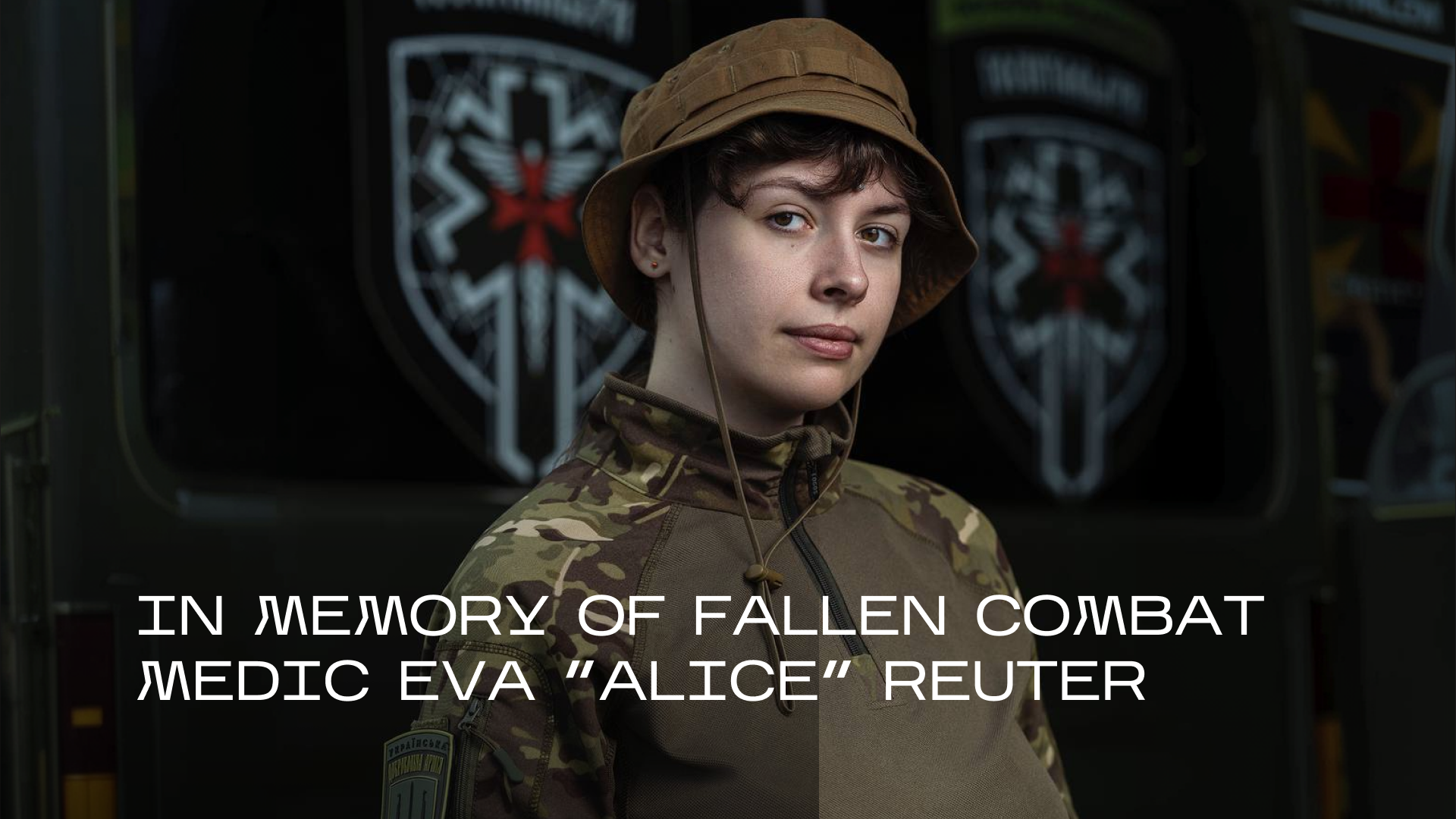 An art historian who became a combat medic, mastered drone repair, FPV drones, 3D printing, led international recruitment, and coordinated a major educational project
  To Mark the 8th Anniversary of the VETERANKA Movement
 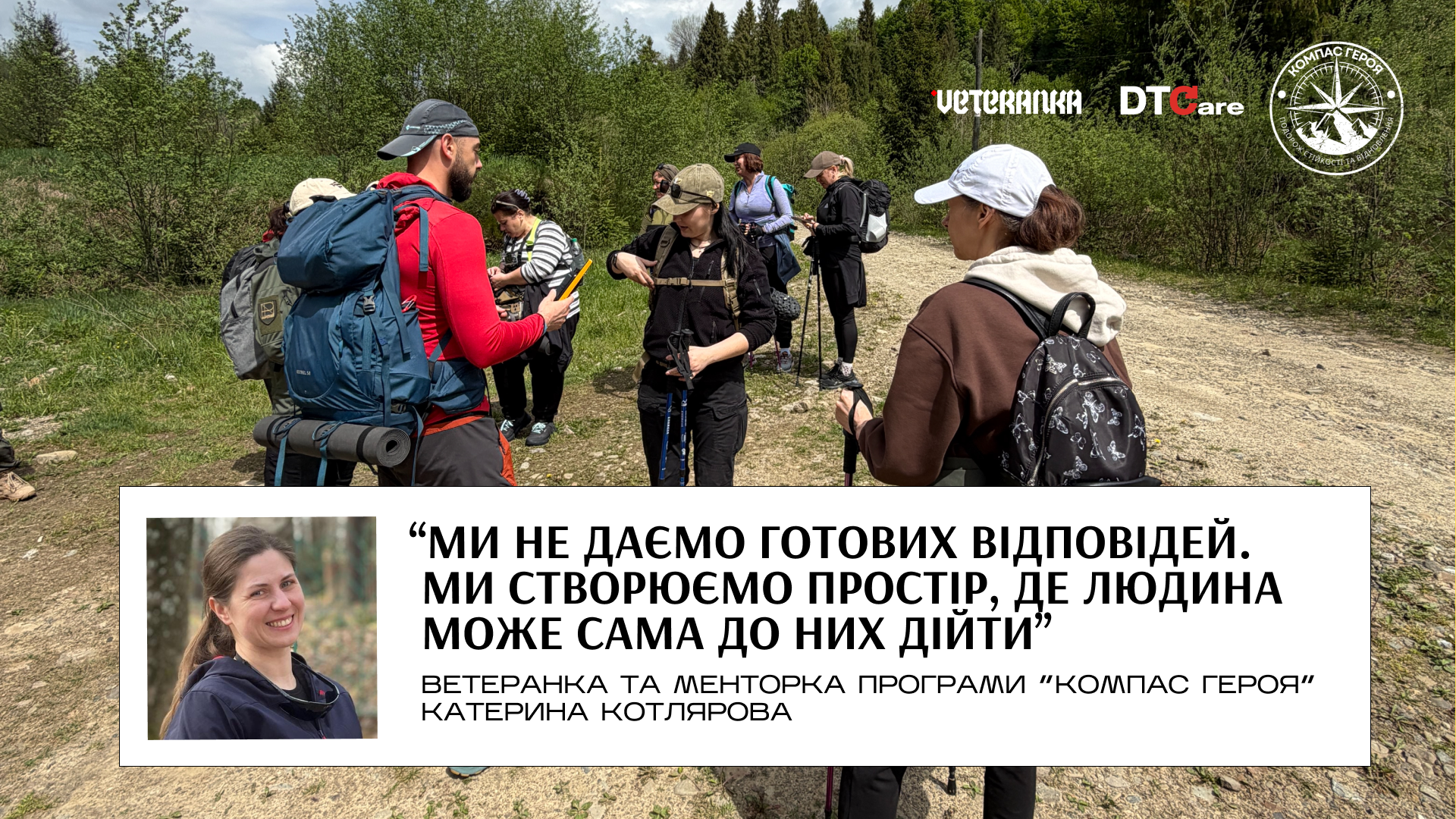 What Awaits Participants of the Hero’s Compass Adventure Counseling Program
 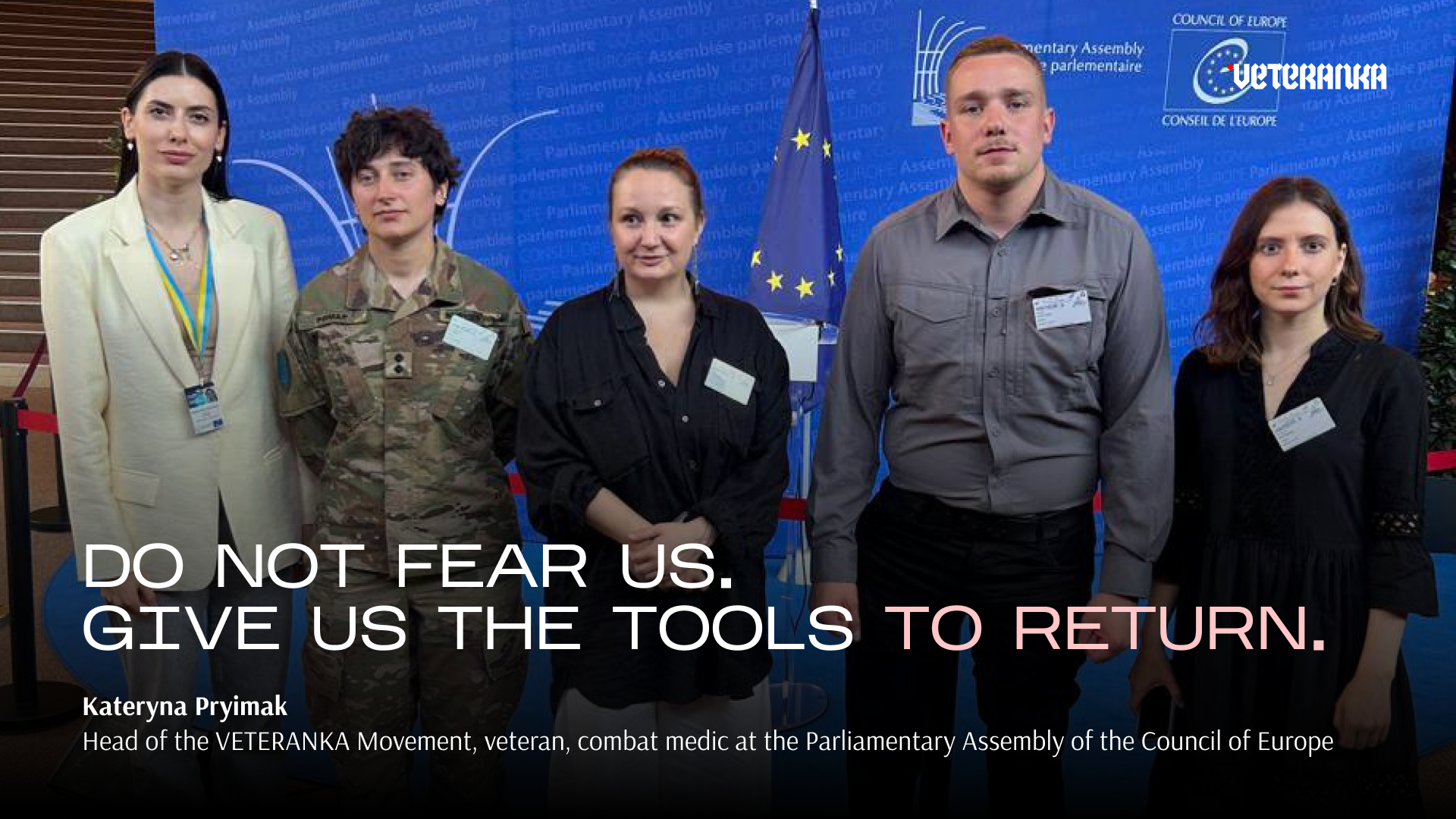 "Do not fear us. Give us the tools to return"
  “Life does not end after service — it becomes different”