Sisters in Arms. Anna Kosinova

Anna Kosinova is a member of “Veteranka,” a former servicewoman of the Armed Forces of Ukraine, a volunteer, and a trained psychologist. Today, she is the manager of the Victory Drones project, which focuses on training UAV operators.
Why glorifying soldiers too much is a bad thing, and why drone operators shouldn’t be denied the right to love animals – read in our feature.

Tell us about your involvement with the topic of drones.
At the onset of War 2.0, around April, Maria Berlinska approached me and mentioned that they had a team and needed assistance. We gathered and started thinking about how we could not only provide drones but also teach people how to use them. Many lives were lost without understanding how a drone exposes the pilot, or even the mere presence of a drone.
I handle more of the technical support regarding Kropyva: installation, authorization, and managerial support for instructors. I also take care of minor communication with the trainees because for those who have undergone our practical sessions, we don’t just leave them out in the field, we continue to support them. In our view, everyone should know how to use a drone; it’s just like a personal weapon. Everyone should be aware of the rules of handling a drone, camouflage techniques, technical specifications, specific usage scenarios, anonymization, and so on.

Which drones are unsuitable for the military and why?
The Mavic 3 Classic falls short for a few reasons. Firstly, it lacks zoom capability, unable to get closer and only displays the image it hovers over. Secondly, and most crucially, it lacks anonymization. There is a solution, but it’s costly in terms of resources and time. Those cheap drones priced at 2,000 hryvnias also don’t make the cut – they’re just toys. The Mavics and Autels are suitable, and there’s a separate significant story with FPV drones.

Around military bases, there are always plenty of animals, dogs and cats. What’s the side effect of this compassion?
People are entirely different, but the point is that, for instance, aerial reconnaissance simply can’t afford to have a fondness for animals because it exposes the pilot. If you take off and there are animals milling around you, that’s a clear sign that someone’s there. Dogs can be compared to tire tracks – they are a sign of human presence,and these places may come under fire.

Who is a hero to you?
I try not to idealize people as heroes. A hero is often portrayed as someone who saves everyone, defeats enemies, and sits neatly shaved while giving interviews. In reality, this is not achievable. When society encounters a real hero, not just an image, disillusionment often follows. That’s why, in my opinion, it’s better to acknowledge heroic deeds performed by ordinary people. War demands acts of heroism every day, whether done consciously or due to circumstances. The person who carries out such an act may not necessarily be someone you admire. This approach is more genuine; there’s no need to justify expectations, and there’s no disappointment in an image.

What happens when people return from war? Many might say after a couple of years, ‘I didn’t send you there; why did you go there? It’s all the same to me; who are you to me?’
Society can be hurtful when you don’t conform to the template it expects. Furthermore, individuals are often reduced to mere functions. In this context, ‘function’ refers to being a hero. While such labels might convey a positive sentiment – after all, being a ‘hero’ is generally viewed as commendable – it remains just that, a label. Behind this label, we fail to see the individual, which often leads to surprise when they don’t align with our preconceived notions. I served as a logistics officer for three years, and until I turned 22, I was even hesitant to call myself a veteran because I hadn’t engaged in combat or patrolled trenches with a rifle. What kind of veteran was I? The fact that I planted fields of corn and repaired machinery in those three years were considered minor details that nobody really cared about. In the broader context of society, a logistics officer isn’t regarded as a heroic figure. And when I was invited to the October 14th celebration and then subsequently ignored, it compounded my existing inner pain. This experience, on top of what I already felt, made the situation even more challenging. However, in 2022, when there was an explosion near my house, I realized that it simply didn’t concern me anymore. I had found my inner confidence in dealing with critical situations.
Today, after War 2.0, the attitude towards the military has drastically shifted. Prior to the bombs falling, people didn’t truly comprehend the realities or how individuals coped with them. There was even an air of contempt. However, now, people have genuinely transformed. This is something I’ve personally witnessed.

With the involvement of the Women’s Volunteer Reserve (WVR), various women’s positions were advocated for in the military. However, is there now an excessive demand on women compared to men?
If you claim to be the world champion in wrestling, you must embody it, and if you call yourself a sniper, it doesn’t matter if you’re a boy or a girl – you must be a sniper and fulfill the role, as it’s a task that can’t be shifted onto someone else; you must know and execute the job responsibilities.
I may not be able to handle heavy physical loads, but my brain is well-trained, and I can use it accordingly: a logistics officer, a communicator, or whatever else. Being a logistics officer and just that – it’s the same job. Take Andriana Arekhta, for instance, a stormtrooper. She’s exceptional in every way, a true leader who knows how to give commands and lead an assault. Her psychological responses are finely tuned, and she motivates others. So why not? But if you’re in the position of a female sniper with bright red nails that are half a meter long – you may look beautiful, but in practice, girls often have to fight tooth and nail for their right to be here and now.
Is a pregnant photoshoot appropriate for a sniper?
I’m against this portrayal because it creates an image of how a woman in a certain position should look: a sniper, which then leads to a pregnant photoshoot, for example. Well, pregnancy has nothing to do with military affairs, so associating the two is simply forcing it into a template. Any news creates a template, a label, an image, emphasizing that we’ll appoint her as a sniper and she’ll get pregnant.

How did you become a part of the Women’s Veteran Movement, and how has it helped you?
I’m really proud to be a part of the Women’s Veteran Movement, and I tell everyone everywhere that I’m a member. Yesterday, I was at the Veteran Hub, and someone asked me: are you a veteran, a servicewoman, or a volunteer?
And I told them that I’m all of these, and also a member of the Women’s Veteran Movement.
For me, it’s a community where you truly belong. You realize that no matter what happens to you, you’re known here, loved, valued. I feel a sense of protection, a sisterhood in arms. These are people who are on the same wavelength as me. We’re in the same boat, understanding why we’re here, and none of us would ever say to another, ‘I didn’t send you there.’
Valiko Korobkadze
 To Mark the 8th Anniversary of the VETERANKA Movement
 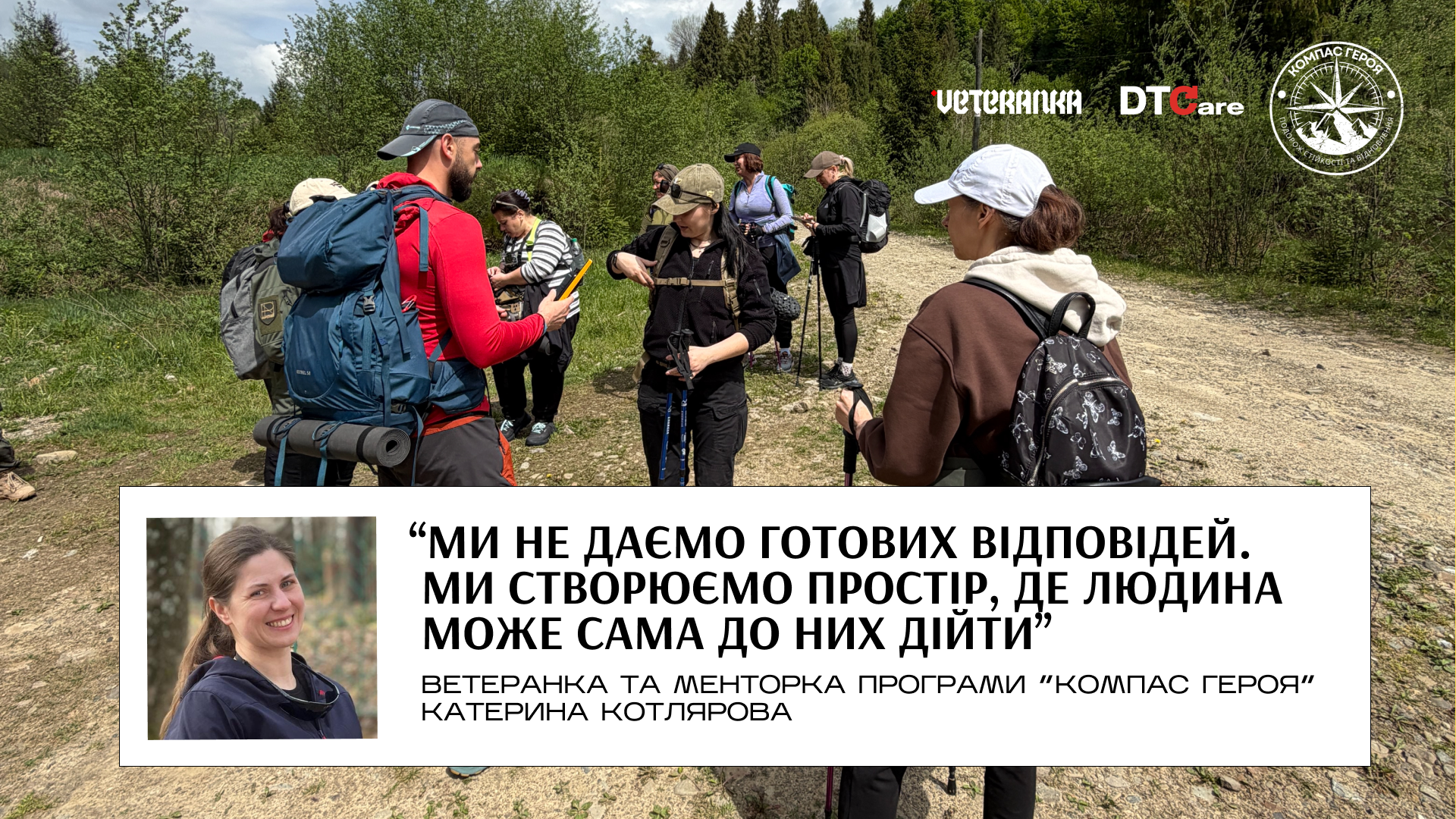 What Awaits Participants of the Hero’s Compass Adventure Counseling Program
 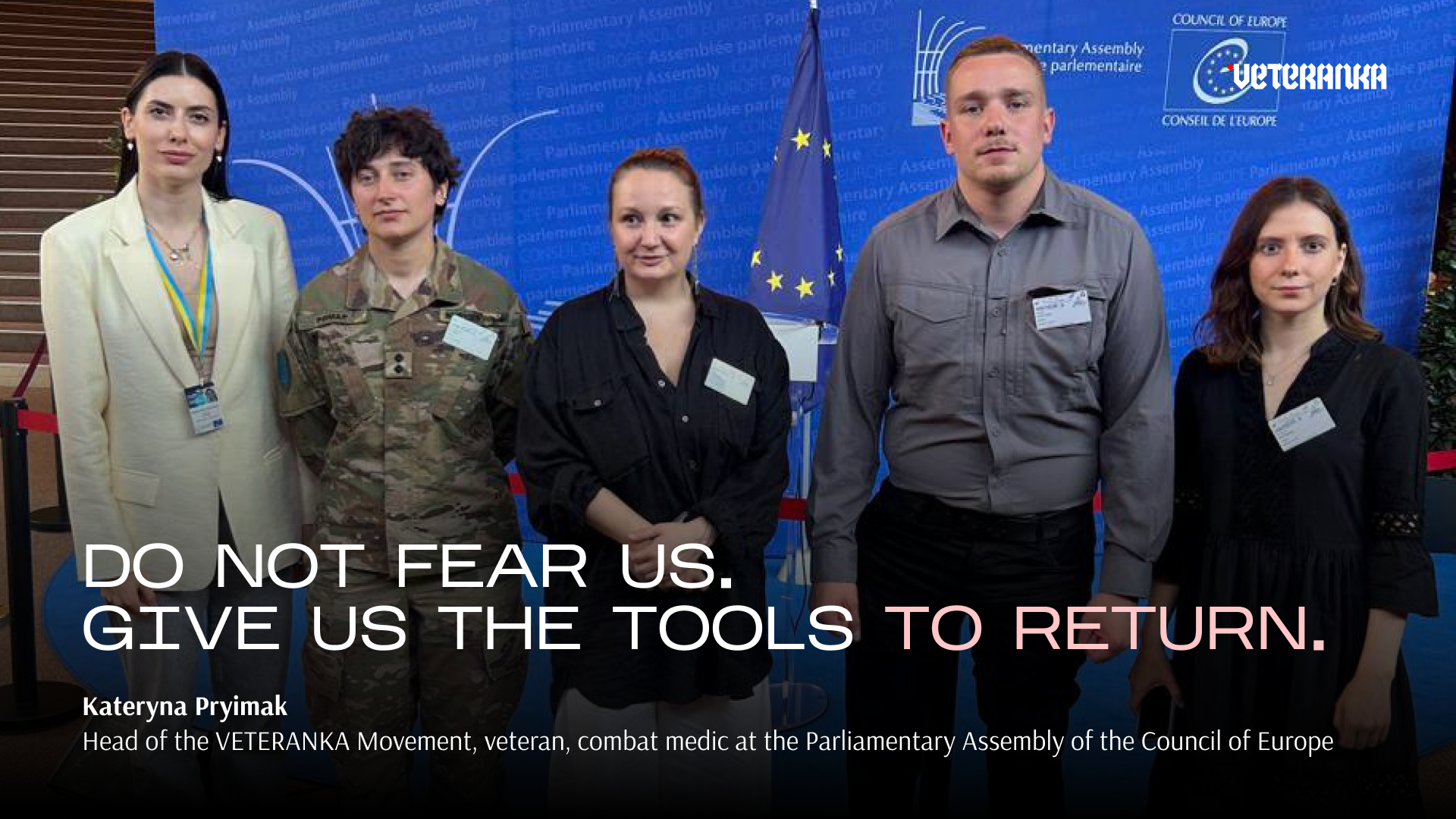 "Do not fear us. Give us the tools to return"
  “Life does not end after service — it becomes different”
  We strengthen evacuation efforts on the most difficult sections of the front and delivers the unique robotic complex “Maul”