Statement and Details of Bill No. 9637

Yesterday, on August 21, 2023, members of parliament registered Bill No. 9637, which proposes an updated definition of the statuses of war veterans. Today, the Committee on Social Policy and Veterans’ Rights issued its conclusion and recommends to the Verkhovna Rada of Ukraine to include the bill in the agenda, designate it as urgent, and shorten the deadlines for submitting alternative bills.
We, a community of expert civil organizations in the field of veterans’ affairs, express our professional disagreement with the logic of defining veterans’ experience proposed by the authors of the bill and see significant risks for veterans and their families in its current version. The adoption of this bill threatens to reinforce the declarative nature of state support and its underfunding. This will lead to a deterioration of veterans’ rights protection and an increase in social tension in society.
We call for:
1) the withdrawal of Bill No. 9637;
2) sending the matter of defining the status of war veterans and their family members for additional refinement. Specifically, we suggest sending the bill back to the authors for further refinement and conducting thorough consultations involving military personnel, veterans, and experts in the field of veterans’ affairs regarding the definition of status and the content of support;
3) adherence to the regulations for developing truly high-quality legislative support for the creation of a veterans’ policy.
You can join civil organizations in signing the statement by filling out the form.
Until now, Ukraine has lacked a unified state policy regarding war veterans and their family members. The veteran’s status system as well as state support does not meet the realities of today and the needs of veterans and their families.
A status is more than just letters in a law. It marks the path of individuals, recognizes their achievements in society, and provides a basis for necessary and dignified support based on their experiences.
The definition of a “war veteran” will affect not only those who have served or are currently defending the country but also those who will protect it in future historical periods.
We jointly express the following remarks about the current version of the bill:
- Abandon the introduction of the new term “Defenders” and “Defendresses” and develop a clear definition of the experience that qualifies someone as a “veteran.”
Military service is a civic duty of Ukrainians. The experience gained by a person during military service or military service in the wartime has further consequences in civilian life. State policy regarding veterans and their families should be directed towards these consequences.
The approach proposed by the bill does not meet the necessary criteria for defining this experience and makes it impossible to determine who exactly is being referred to. The use of proposed terminology is possible in everyday communication about our defenders, but on a legislative level, new terminology may cause legal uncertainty.
The term “Defenders and Defendresses” has emotional connotations, and its adoption in legislation as well as a specific procedure for acquiring such status can lead to a subjective division of citizen-defenders into “defenders” and “non-defenders.” This means that individuals who have not formally received the status of “Defenders and Defendresses” will not be considered defenders, even though they may be actively defending the country at present.
Furthermore, proposed logic repeats the mistake of past policies, namely, endowing status based on the timing of acquiring experience rather than the actual experience gained. In particular, dividing military personnel based on the time of experience acquisition may lead to unfair comparisons among those who have defended the country during different historical periods: during the Anti-Terrorist Operation (ATO), Operation of United Forces (OOS), and full-scale Russian invasion, who have already obtained statuses as combat veterans, war participants, individuals with disabilities due to the war, and war veterans. In the ranks of the Armed Forces and Defense Forces, citizens fulfill their duty and are not always free to choose their own future. Currently, there are individuals in the military who were under 18 during the ATO/OOS and those for whom service during the full-scale invasion is not their first experience in defending the country.
Exalting the heroism of some over others will also leave those currently applying for veteran status (not all of those who defended Ukraine in February 2022 have obtained the status to which they are entitled) in an uncertain situation.
Creating a new status can indeed expedite the distribution of preferential support, as there would be no need to change current legislation and face the limitations such a process entails. However, this solution will only yield a temporary effect and will not contribute to the development of a consistent, sensible, and systematic policy. It will lead to a hasty, ill-considered decision and hinder efforts to establish a consistent approach.
- Rjeect the categorization of veterans’ experiences.
The bill contains a proposal to categorize veterans’ experiences based on the duration of their service (the number of days/months they participated in the defense of Ukraine). We consider such a criterion insufficiently developed because it introduces an artificial division among military personnel and veterans based on subjective indicators. The same duration of service can occur under different circumstances and can have different consequences for the participant. Furthermore, such a division demonstrates a lack of respect by the state for the principle of subordination in the Armed Forces since military personnel cannot always choose the tasks or the period during which they will perform them but instead obey their superiors and carry out the assigned tasks. Any distribution of service experience should correspond to the specific nature of military service and requires consultation with the Ministry of Defense, the Security Service of Ukraine, the State Border Guard Service, and other law enforcement agencies.
Categorizing veterans based on the number of days they participated in the defense of Ukraine will lead to the division of the veteran community and increase social tension. The bill also contains retroactive provisions, such as for ATO participants who received a disability of the II degree, belonging to the second category of veterans is proposed. At the same time, a separate status as a “person with a disability due to the war” is retained, which will complicate the choice and issuance of statuses for veterans. It is worth noting that some of the categories do not provide for the inclusion of individuals who participated in the OOS.
- Ensure the protection of veterans’ rights and conduct additional analysis of the bill’s risks for specific categories of veterans.
Expanding the grounds for revoking veteran status (due to the commission of any deliberate serious or particularly serious crime, which can be committed after leaving the service) can lead to the revocation of a person’s status without a causal link between the crime and participation in the defense of Ukraine. This will significantly worsen the legal protection of veterans and their perception in society. Veteran status represents a person’s past experience gained during military service. Events in civilian life should not serve as a basis for revoking this status.
4) The proposed law does not provide realistic and sufficient mechanisms for financing support.
According to the project, the cost of the social support package for each individual category of Defenders of Ukraine, the maximum amount of the package, the procedure for providing social support, and payment terms are determined by the Cabinet of Ministers of Ukraine. This creates a risk of legal uncertainty for veterans (the social support package will be changed by the Cabinet of Ministers depending on the budget for the respective year, which may reduce state support in contradiction to multiple decisions by the Constitutional Court regarding the unconstitutionality of such mechanisms). The project also does not provide financial and economic justification, and among the sources of funding for support, it mentions not only the state budget but also local budgets and other sources not prohibited by law. There is a risk of declarative benefits or the ranking of their quality depending on the local budget (and, accordingly, on the veteran’s place of residence).
5) The new law is not necessary for the automation of granting the status of combatants.
One of the arguments of the authors of the bill regarding its adoption is the acceleration of processes related to the automation of issuing combatant certificates. However, there is no need to create a new law to achieve this goal. A cross-agency process is already underway involving experts from the Ministry of Defense, the Ministry for Veterans Affairs, the Ministry of Digital Transformation, and some decisions are already under consideration by the Cabinet of Ministers. On the other hand, in our opinion, the adoption of this bill and the introduction of new statuses will require the development of completely new data routes, which may lead to a significant delay in the implementation of decisions for veterans. The introduction of a Unified Register of Servicemen may be an effective solution for further development of the (semi-)automatic issuance of combatant certificates. However, it should be noted that the mentioned register is a more long-term and extensive project that includes measures for design, deployment, and information security, which are not sufficiently elaborated at the moment.
Supported by:
“Juridical Hundred” NGO,
“Veteran Hub ++” Charitable Foundation,
“Principle” Legal Center for Servicemen,
“Women’s Veteran Movement” NGO,
“Volunteers” NGO,
“Space of Possibilities” NGO,
“Women of Steel” NGO,
“ATO Veterans Association” NGO,
Public Council of the Ministry of Veterans Affairs of Ukraine,
“Volunteer Association “VESTA” Charitable Organization,
Volunteer Service of the Lviv Military Hospital,
“ATO Participants Association of Odesa Region” NGO,
“Polygon 56 Berdiansk” NGO,
“Families of Chernobyl NPP Defenders” NGO,
“Veterans’ Space” NGO,
“About Whom They Are Silent” NGO,
“Veterans for Medical Cannabis” NGO,
Charitable Organization “Charitable Foundation “Aid to ATO Veterans” Phoenix”,
All-Ukrainian Public Movement of Mothers and Relatives of ATO Participants “Berehynia,”
“Vinnytsia Analytical and Educational Center “Veterans’ Space,
” “Veteran Hub Odesa” NGO,
“Support of Titans” NGO,
“After Service” Charitable Organization,
“Civil Security” NGO,
“Rights Protection Group “SICH” NGO,
Mykolaiv City Center for Support of War Veterans,
“Veterans’ Brotherhood” NGO,
“Association of Disabled and Veterans of Khmelnytskyi Region” NGO.
 To Mark the 8th Anniversary of the VETERANKA Movement
 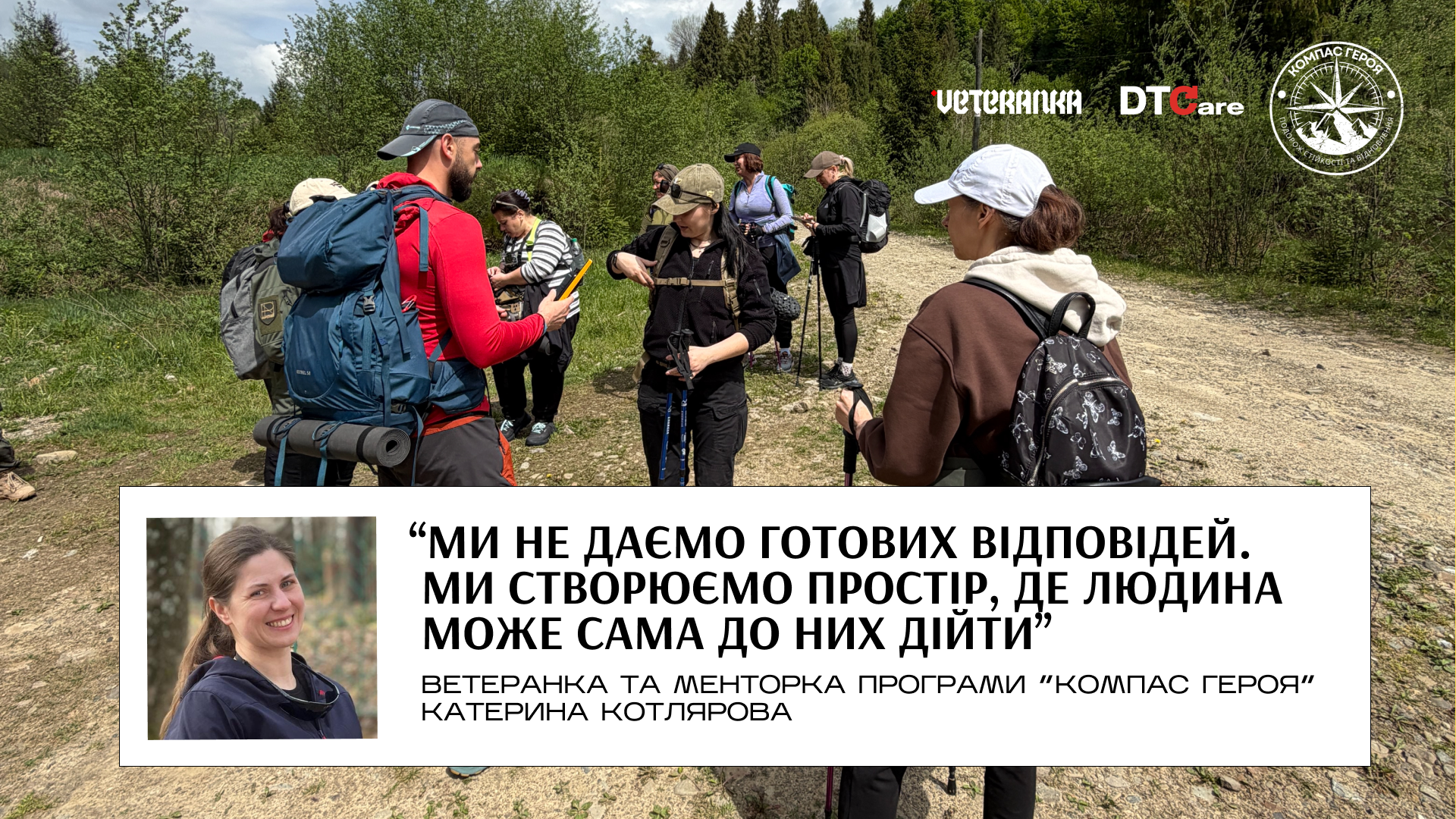 What Awaits Participants of the Hero’s Compass Adventure Counseling Program
 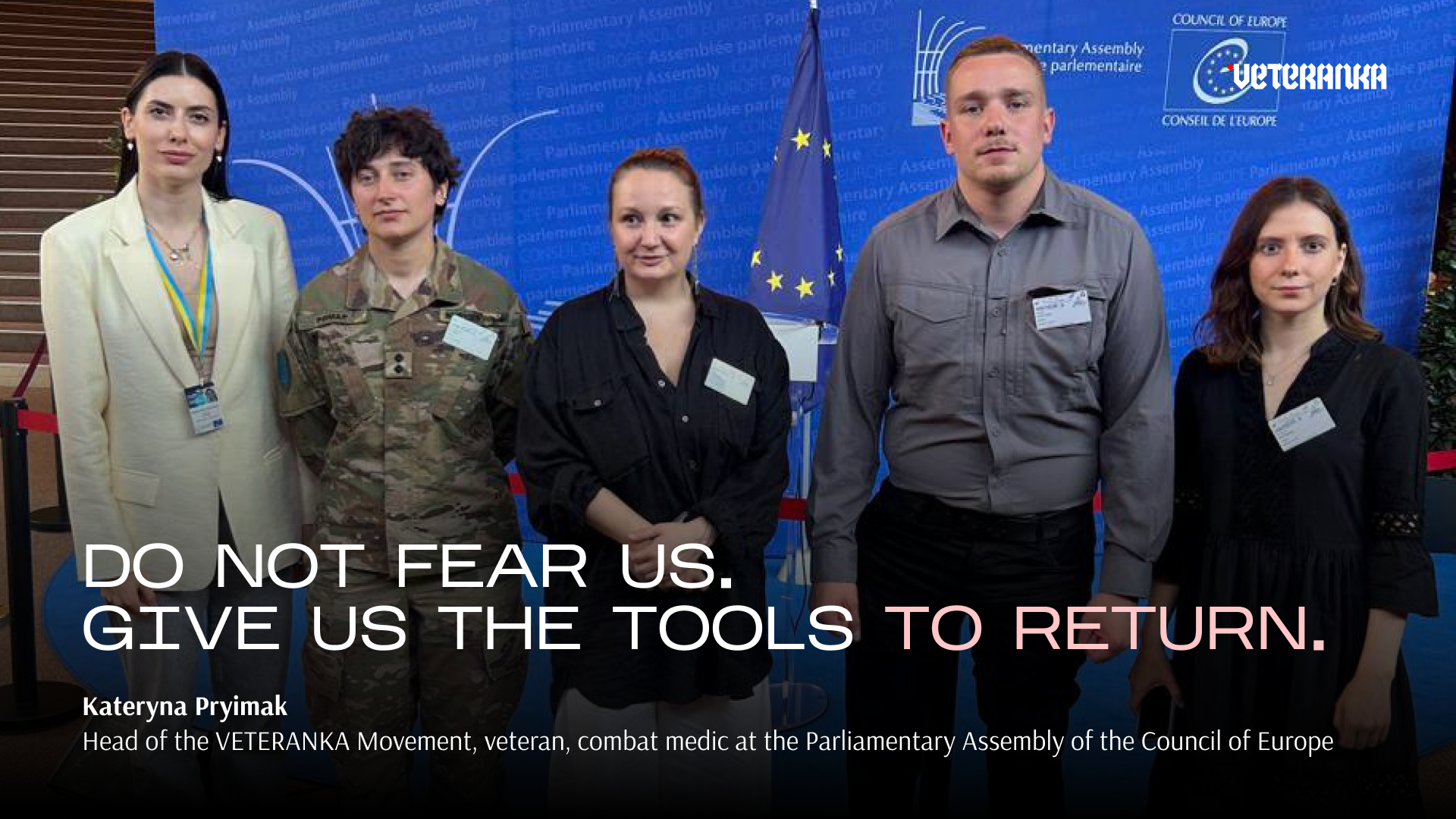 "Do not fear us. Give us the tools to return"
  “Life does not end after service — it becomes different”
  We strengthen evacuation efforts on the most difficult sections of the front and delivers the unique robotic complex “Maul”