Three stories about the war. Anzhelika Volovych

Anzhelika Volovych, an uncrewed aerial vehicle (UAV) pilot and volunteer of the Armed Forces of Ukraine, shares her memories from the war zone.
Read three stories about her work in the Ukrainian Air Force, her most difficult memories from the war, and the homeless dogs of Bakhmut.
A story about the report from ru💩💩ians
Now I work as a part of the FPV drones crew, where I am a navigator, although I prefer to fly. I love FPV kamikaze drones and the fact that with their help we can reduce the number of the enemy. From time to time, the commander gives me the opportunity to be a drone pilot and this story is about one of those moments.
Imagine, I fly to a target for the first time in the “free hunt” mode. I’m a little stressed because I need to identify a moving target and catch up with it. A “loaf” (a type of off-road van (UAZ-452) – editor’s note) comes my way, I aim at the target, and 5 meters from it, I lose contact with the drone. My team and I assumed that the drone could have been stopped by a tree branch since the target was moving along a narrow road with dense trees on both sides. I was upset. It’s hard for me to forgive myself for losing the drone because people have paid for it. But the next day I came across a video shot by the russians and what do you think we see on it? The same “loaf”, on the same road, in the same place where I saw it last in the FPV drone camera, only now I see the end of the scene – the van burned to the ground!
Sometimes, you can see the results of your work later thanks to the enemy.

A story about one of the most difficult memories of the war
It so happened that I got my first combat experience in Bakhmut in the winter of 2023 as part of the volunteer battalion. The task was to provide a picture from a Mavic drone to support our force’s attack. The drone camera was my eyes and I had to see for the first time how our Heroes fell one by one. I heard them screaming into the radio, asking for help in agony. The shelling was constant, and they buried themselves in the trenches to somehow hide from enemy fire. All I was allowed to do was to keep the drone steady and film everything, so that the command could decide on the next course of action. This feeling of not being able to help, and just watch, – it’s unbearable.
After some time, our Beha arrived, suppressed enemy fire and evacuated our troops. Then, from the group of 12 people who went on the assault, only three remained alive.
These events are still in front of my eyes like a terrible dream.
Now imagine that this happens every day. Even now, at this very moment, one of our best men is dying protecting us.

The story about the dogs of Bakhmut
There are a lot of stray dogs in the frontline cities. And this is a huge problem. Most of them die a terrible death.
I can’t forget the two red dogs that came to our position when we were stationed in Bakhmut. They were very gentle and kind, always asking to be petted. They used to run to the basement with us when heavy shelling began. I wanted to take them with us when we were leaving, to find them a home, but the commander did not allow it. So the dogs stayed there and, most likely, died there, because not much remained of Bakhmut city. I’m with one of those red dogs in the photo.
Now I am serving in another unit and trying to save as many of these innocent animal lives as possible. My team sometimes has to travel with a furry passenger. I am incredibly grateful to my brothers-in-arms for this support.


Editor: Marysia Myanovska
 To Mark the 8th Anniversary of the VETERANKA Movement
 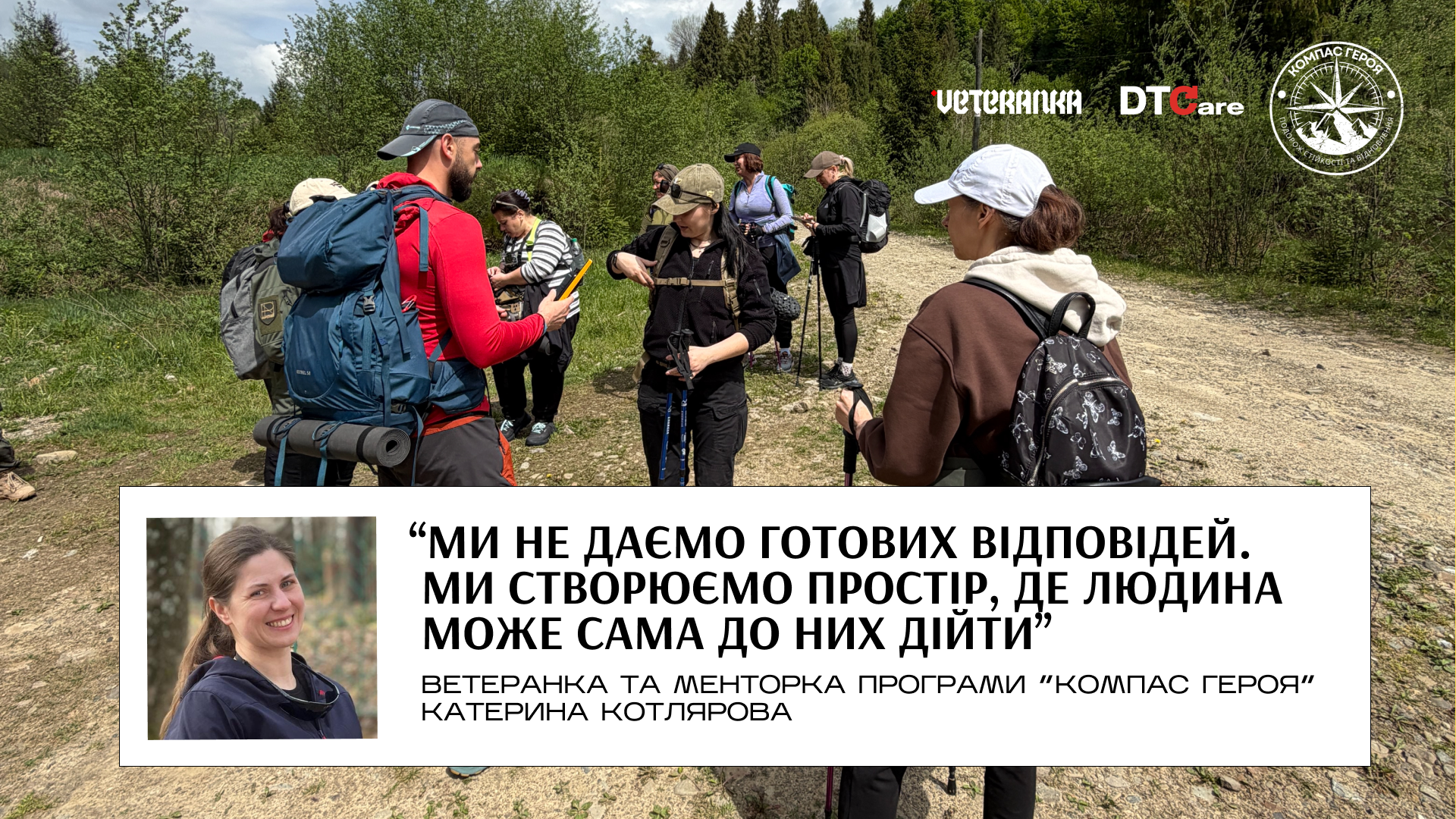 What Awaits Participants of the Hero’s Compass Adventure Counseling Program
 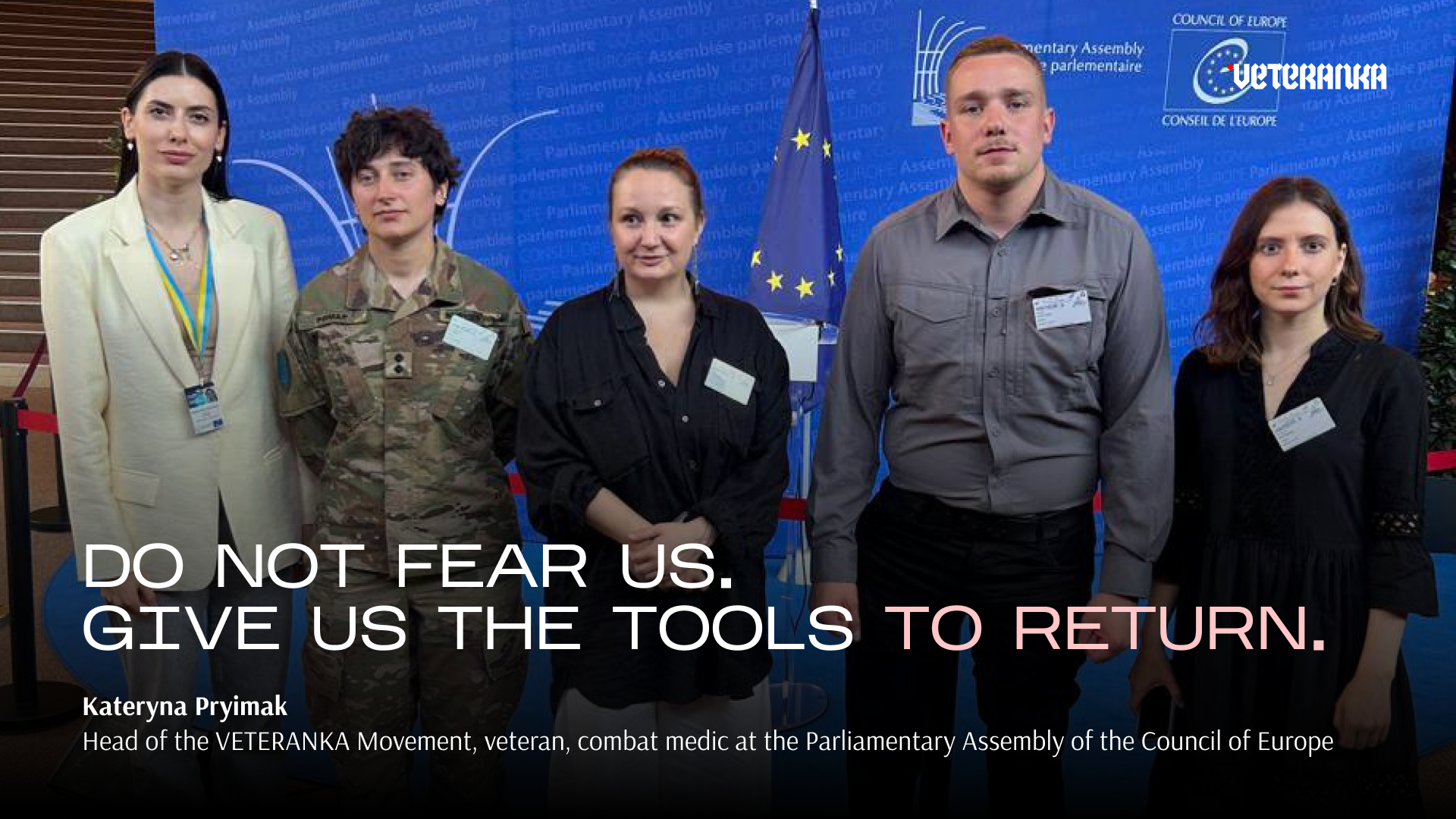 "Do not fear us. Give us the tools to return"
  “Life does not end after service — it becomes different”
  We strengthen evacuation efforts on the most difficult sections of the front and delivers the unique robotic complex “Maul”